The post The True Cost of Employee Turnover Depends on Who You Lose appeared first on BC Jobs Blog.
]]>We all know that high turnover is costly to an organization’s productivity, morale, and bottom line.
In fact, I could easily fill an entire book with stats about the average cost of replacing an employee! but as retention costs vary significantly from industry to industry and business to business averages will be of very little use to you!
To give you an idea of what replacing an employee will cost you, here’s a basic formula from Karlyn Borysenko:
- Entry-level employee – Between 30% and 50% of their annual salary to replace.
- Mid-level employees – Upwards of 150% of their annual salary to replace.
- High-level or highly specialized employees – Approximately 400% of their annual salary to replace!
If you want to do an even more detailed analysis, Greg Willard published a formula specifically designed to calculate the cost of employee turnover on ERE.
No matter how your specific numbers pan out, I think they will still show that retention is a good investment!
The typical response, upon examining the high cost of turnover, is to try and discover what makes employees stay. This is a logical step, but it is still highly flawed.
For example, CareerBuilder’s survey of 3,991 workers attempts to provide employers with an answer to their retention woes by exposing what motivates employees to stay with a company.
When CareerBuilder asked candidates what would motivate them to stay, here are the answers that they gave (they were allowed to provide multiple answers):
- Increase salaries – 70 percent
- Give better benefits – 58 percent
- Provide flexible schedules – 51 percent
- Increase employee recognition (awards, cash prizes, company trips) – 50 percent
- Ask employees what they want and put feedback into action – 48 percent
- Increase training and learning opportunities – 35 percent
- Hire additional workers to ease workloads – 22 percent
- Provide academic reimbursement – 22 percent
- Carve out specific career paths and promote more – 21 percent
- Institute a more casual dress code – 14 percent
CareerBuilder used the results of this study to advise that companies invest in better benefits and culture related fixes, such as flexible working hours. This advice is generally well received as it means that improving retention does not have to involve salary increases. CareerBuilder survey doesn’t differentiate between workers based on performance level. (https://igppc.com/)
But the advice given is flawed.
CareerBuilder’s survey doesn’t differentiate high performing employees from average and low performing employees. If it did, it’s unlikely that they would be able to downplay the importance of increased salary.
Here’s why:
A high performer delivers 400% more productivity than the average performer.
So, if your retention strategy only helps you keep average and low performers, and fails to retain top performers, then it is not a very effective strategy.
Excluding qualifiers such as performance level is often justified with the excuse that top performers are more engaged and are, therefore, more satisfied with their job and less likely to abandon ship. Recent findings by SAP show otherwise:
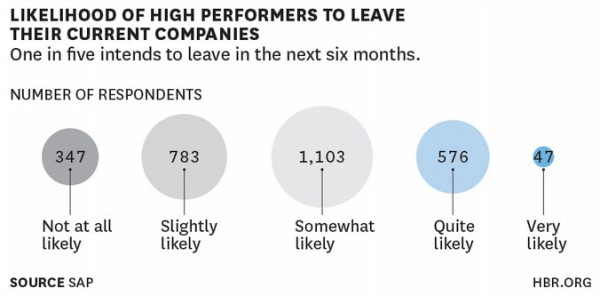
Like CareerBuilder, SAP also found that base pay and bonus pay was the top influencer on an employee’s decision to stay at their job.
Unlike CareerBuilder, SAP differentiated between employees based on their performance level.
Their research shows that top performers value base pay and bonus pay significantly more than both average and low performers. Thus calling into question the idea that you shouldn’t focus on monetary increases as the key to retention.
Karie Willyerd, one of the SAP study’s authors suggests that a workable take away from their findings is to provide “differentiation in annual increases with significantly more variation in bonus pay for the top five percent of performers.”
In other words, find a way to pay top performers more that won’t create jealousy and unrest amongst the team.
Another huge contributor to top performing candidate’s job satisfaction was regular feedback.
Most of the employees surveyed expressed that they expected (and desired) monthly sit-downs with managers/superiors to assess performance. Only half of these employees reported actually receiving the monthly feedback that they expected.
The implications of this are pretty clear. To retain top performers, give them the feedback that they so desire!
All things considered, even if it means increasing salaries and bonus pay, it still costs significantly less to retain than to replace.
Canadian employers, faced with an increasingly competitive hiring market, and a rise in the popularity of aggressive hire to hurt strategies, need to make retention a top priority.
To keep your best employees from becoming your competitor’s top performers, an effective retention strategy with a focus on hearty bonuses and consistent feedback is you best weapon.
The post The True Cost of Employee Turnover Depends on Who You Lose appeared first on BC Jobs Blog.
]]>The post Writing Interview Invitations & Templates appeared first on BC Jobs Blog.
]]>
I hate to be the bearer of bad news, but the candidates applying for your job postings, well… They are also applying for jobs at other organizations!
Okay, so you probably know that already.
Just because a job seeker applies for a position with your company, doesn’t mean that you’ve got dibs on them, it doesn’t even mean that they will accept an invitation to an interview.
If you want to snag the best talent, then you’ve got to make your interview invitations enticing. Ideally each interview invitation you send would be tailored to the specific applicant with an eye to their individualized career objective… But, rarely is this ideal situation actually feasible!
Writing a personalized invitation to every single applicant is not an option if you plan on interviewing many candidates.
Thankfully, with some good copywriting, you can make your generic email invitation seem personal.
Here are two simple templates, one informal, one formal, and both basic enough to work for most interview invitations without sounding overly generic.
Informal:
Subject
We would love to interview you for the [job title] position at [company name]
Body
Hi [first name],
Thank you so much for applying to become a part of our team.
Your application really stood out to us, so we would like to invite you for an interview [at our office / via Skype / via phone] to tell you a little more about the position, get to know you better, and see if this job is right for you.
[Insert any details about the interview: what the candidate needs to bring with them, important details about the location, what the interview will entail, and approximate length.]
Please let me know which of the following times work best for you:
-[Day, Time 1, place with address]
-[Day, Time 2, place with address]
-[Day, Time 3, place with address]
You can always reach out to me if you have any questions before the interview. My contact details are [contact information]
I look forward to meeting you,
[Your name]
Informal:
Subject
Invitation to interview for the [job title] position at [company name]
Body
Hello [name],
Thank you for applying to [company name].
We were impressed by your application.
Your qualifications make you an excellent candidate for this role, so we would like to invite you for an interview [at our office / via Skype / via phone].
During the interview, we will explain more about this role, our company, and of course, get to know more about you.
[Insert any details about the interview: what the candidate needs to bring with them, important details about the location, what the interview will entail, and approximate length.]
Please tell us which of the following dates is most convenient for you:
-[Day, Time 1, place with address]
-[Day, Time 2, place with address]
-[Day, Time 3, place with address]
If you need to reach out to me before the interview, then please contact me at [contact information]
I look forward to meeting you.
Regards,
[Your name]
These two templates are a solid starting off point. Before using either of them, it is important that you read the invitation template over and then change the wording so that it fits with your communication style. In short, adjust the invitation so that it sounds like you!
In short, adjust the invitation so that it sounds like you.
Once you’ve reworked your template remember to save it for future use.
Happy hiring!
Unlimited job postings for $300/month at BCJobs.ca. Start hiring today!
Also read:
The post Writing Interview Invitations & Templates appeared first on BC Jobs Blog.
]]>The post The Best of Canadian HR and Recruitment Blogs appeared first on BC Jobs Blog.
]]>Googling “best HR blogs”, or “best recruiting advice websites” brings up page after page of top 10’s and curated lists… All of them featuring predominantly American or UK based blogs.
Unfortunately, there simply aren’t a lot of Canadian blogs out there (relatively speaking), let alone Canadian blogs specifically geared towards HR.
But, what we lack in quantity, we make up for in quality!
I love Canadian blogs, especially the ones on this list:
BCjobs.ca’s Top 7 Canadian HR and Recruiting Blogs
HRVoice
HRVoice is HRMA’s online information centre.
This blog is a must read if you want to keep your finger on the pulse of Canadian human resources. They also post articles written by respected HR professionals.
Check out Effective Communications and HR: Making the Connections.
HR Inner Circle
Who doesn’t want to be part of an inner circle!?
HR Inner Circle shares articles from a variety of different sources with a focus on human resources news, ideas, and innovations.
Check out The 4 Imperatives of Implementing a Sound Workplace Wellness Strategy.
Randstad Canada Blog
Covering topics for both ends of the hiring spectrum, Randstad’s blog covers a wide range of topics.
You’ll find articles written for employers, recruiters, the HR department, and jobseekers, but what really sets Randstad apart is their special attention to women in the workplace.
Their series, Women Shaping Business, is a wonderful resource for women and anyone looking to promote diversity in the workplace.

From one of Randstad’s Surveys
HRM Online
Dedicated to covering human resources news, opinion and analysis, HRM Online is pretty old school in their presentation. Their site resembles newspapers and print journals and the articles they publish are more formal in tone and delivery than typical blogs.
Personally, I find this approach refreshing and always feel smarter after paying HRM Online a visit.
Check out Preparing For a Less-Loyal Workforce.
Plugged In Recruiter
This lovely blog is full of wisdom straight from HR expert Susan Wright-Boucher herself.
Susan’s writing is a pleasure to read, and her knowledge is evidenced in every one of her articles! This blog is a personal favorite for sure.
Check out 5 Tips For Writing Insanely Good Job Ads.
Talent At Work
This is by far the prettiest blog on the list!
Talent At Work is run by Goldbeck Recruiting Inc., the blog focuses on recruiting and HR with a healthy dose of business advice and inspiration.
They also publish informative reports about the Canadian recruiting and workforce landscape that are definitely worth a read.
Check out Fall Hiring Extravaganza: 45% More Job Postings in First Week of September.
Open View Labs Blog
This blog isn’t technically a blog, but it is full of helpful advice for anyone looking to grow their organization.
The “recruiting resources” section of Open View Labs shares articles about hiring best practices, recruiting tips, and information about retention.
Check out The 3 Worst Hiring Mistakes Startups Make.
We won’t be so cheeky as to include the BCjobs HR Advice blog in this list, but we hope you’ll consider us!
These are our favorites, we would love to hear about the blogs that you love. Please tweet us @HRAdvice or post them on the BCjobs.ca Facebook Page. BCjobs.ca Facebook Page.
The post The Best of Canadian HR and Recruitment Blogs appeared first on BC Jobs Blog.
]]>The post 5 Tips for Recruiting Canadian Tech Talent appeared first on BC Jobs Blog.
]]>
The struggle for recruiting top tech talent in Canada is real. And things are about to get even realer.
Canada has no shortage of incredible tech startups and companies. Canada based companies like Shopify, Hootsuite, and Wave are a testament to Canadian innovation, yet they face a growing challenge when it comes to hiring.
There are over 350, 000 Canadians living in Silicon Valley, a number that concerns companies like Vancouver-based Hootsuite.
According to Hootsuite’s CEO Ryan Holmes, “Canada suffers from a growing shortage of computer developers and software engineers.” (Source)
Yet these companies still manage to successfully run their operations out of Canada.
Hootsuite’s head of human resources, Ambrosia Humphrey’s explains that in order to win the war for talent, Canadian companies “have to do a better job of promoting ourselves!”
If you’re looking to attract the best and brightest tech talent that Canada has to offer, you need to make recruiting a priority.
Here’s how:
5 ways to win the war for tech talent in Canada
Go Niche
Local job boards, local tech organizations, and tech specific sites are the best places to find the talent you seek.
When it comes to recruiting for technology-related positions, it’s quality over quantity every time!
You’re not going to find quality on Craigslist.
Instead try searching tech havens such as Github, or Stack overflow. Use Canadian specific job boards, and connect with local tech organizations such as the BC Technology Association.
By focusing on these channels your recruiting will be more targeted, focused, and effective.
Know Your Stuff
Smart candidates know when the person trying to recruit them doesn’t understand the job that they’re recruiting for, and it’s a huge turn-off.
Not only that, but an recruiter who does not understand the tech a candidate will be working with, simply doesn’t have the knowledge they need to recognize a quality hire, or even ask the right interview questions!
This goes both ways though.
If you neglect the importance of HR skills in the hiring process, and choose to use a project manager, or lead developer to run the hiring process, then you’re equally at risk.
Recruiters and HR understand how to conduct a proper interview, and know that there is no such thing as a perfect candidate, only the right candidate.
Make Your Jobs Searchable
Where do tech savvy candidates look for work?
You guessed it, the Internet!
If you want to reach them, then you need to make your jobs discoverable.
Social recruiting is an excellent way to recruit top tech talent, optimizing your job posts for search engines is another, and so is building an online employer brand.
Employee Referrals
Employee referral programs are the best source of quality candidates. They cut sown on time to hire significantly, and they generally have the best ROI of any recruitment process.
Thanks to social networks like LinkedIn and Facebook, your employees are still in touch with a lot of the people they went to school with.
People with similar skills.
Skills that you want your candidates to possess.
Creating an employee referral program that encourages and rewards candidates for recruiting their friends, is one of the best things you can do for your tech recruiting strategy.
Be Canadian
Tug on your potential candidate’s heartstrings by appealing to their love of country.
Most Canadian’s are pretty proud to call this country home. Make the fact that your company is Canadian a part of your employer branding and you’ll have an emotional appeal on your side that competitors to South cannot match!
If you need a point of pride to get you inspired, remember that much of the top tech talent in the world is cultivated on Canadian soil.
In fact, the University of Waterloo is considered a top feed school for Silicon Valley, go King Warrior!
Read also:
- How to Ensure a Successful Probationary Period
- How to Write More Effective Job Posts
- Are your hiring practices working?
The post 5 Tips for Recruiting Canadian Tech Talent appeared first on BC Jobs Blog.
]]>The post Why an Honest Culture is Essential for Growth appeared first on BC Jobs Blog.
]]>This is something that I have learned from spending the last decade with a man who is terrible at little white lies.
Having your husband gaze into your eyes and tell you, “That haircut is weird!” or “You look kind of puffy, are you tired?” is no fun.
His annoying little habit, although hard on my ego, actually makes him an incredible employee.
Why?
Because he refuses to be a yes man.
My husband’s enduring candor means that he is unwilling to ignore problems in an attempt to keep feathers unruffled.
Today’s workplace culture is so determined to avoid conflict at all costs, that a simple willingness to point out cold hard truths can save companies from investing unsoundly, moving forward on flawed projects, and general self-destruction.
Denise M. Morrison, CEO of Campbell Soup blames “too much emphasis on reaching consensus” for lagging sales back in 2011. She credits the decision to shift from a “play it safe culture” to one that empowered employees to act boldly, and go against the grain, for turning the company’s fortunes around. (https://www.hanakaimaui.com/)
Read more about how Denise cultivated a bold company culture.
According to many top CEO’s, creating a company culture that invites honest feedback, and encourages employees to speak up, and challenge the status quo is vital to an organization’s ability to grow and innovate.
But, I still don’t think my husband would be doing his company’s CEO any favors by telling him that he looks tired. Thankfully (for our financial situation and my ego), he has gotten a lot better at learning the difference between constructive honesty, and brutal truth telling!
“There is a vast difference between picking projects apart and picking people apart.” – Gregory Ciotti, Help Scout and Sparring Mind
Pointing out previously missed, yet possibly fatal flaws when working on a project is constructive, even though it isn’t fun for anyone involved.
Pointing out every single rough patch along the way isn’t helpful, and it can be horribly demoralizing for your team.
Reaching a balance is difficult. Navigating employees’ emotions, navigating your own emotions, and maintaining positivity, whilst maintaining a culture that both accepts and encourages constructive critique is difficult.
Almost as difficult as finding a gentle way to tell your spouse that their favorite pair of pants are no longer flattering… But it can be done!
Here are a couple of tips:
Critique the project, NOT the person
Make sure that you direct your critiques towards the project, how it is moving, and the areas that need improvement, not towards individuals, or their character traits.
Once things get personal, rationality flies out the window, and any insights that may have been gleaned are lost to emotion.
For example:
“Honey, those pants are just too worn out, we should replace them.”
VS
“Honey, you just can’t fit into those skinny jeans anymore.”
Make it about the pants project, not the person.
Offer a solution
Notice the suggestion to replace the pants, this provides a new thing to focus on, a common goal that will bring the team together, and move the project forward.
Not to say that you always have to offer a great solution, but trying to provide some insight or general direction will make any negative feedback easier to swallow.
Maintain control
Just because you are encouraging your team to be real with you, and each other, does not mean you should encourage them to say whatever the heck they want.
You want to cultivate a company culture that encourages employees to challenge the status quo and ask hard questions.
You do not want to encourage bullying, or personal attacks.
Step in when you see team members cross this line, be firm with them so that they know that the behavior will not be tolerated, but also be very clear with them about why you are stepping in.
Not everyone has great, or even decent social skills. Your hard-truth telling employee may not even know that they have crossed a line. As their leader ,you must clearly explain the difference between being brutally honest, and constructively critical. You may even need to break down exactly how their behavior is inappropriate and advise them on how to proceed in the future.
Be patient with your team, listen to their feedback (even when it stings), and, as always, lead by example.
You will be rewarded with innovation, growth, and success.
PS
I really like my new pants!
The post Why an Honest Culture is Essential for Growth appeared first on BC Jobs Blog.
]]>The post How to Bring Your Recruiting into the Future appeared first on BC Jobs Blog.
]]>
New technologies are changing the rules of the war for talent.
Competitors are targeting your candidate pool. On a global scale, with multiple networks, and innovative tactics based on big data.
Resistance to adopting these technologies is futile.
But, why resist?
The future of recruiting is both social and automated, and these two trends will make your recruiting easier, and more effective.
So don’t wait, bring your recruiting into the future today!
Social Recruiting
Social media has become an integral part of the recruitment process, with 94% (Source: Jobvite) of companies using social networks as a key part of their hiring strategy.
Social media is being used to interact with candidates, post jobs, and boost employer brand.
In the past, big companies, with widely recognizable brands had a huge advantage over small – medium sized companies… And they still do.
Social media does, however, give non-Fortune 500 companies a much better chance at creating an employer brand to attract job seekers.
Take the recruitment video, for example. You can now shoot an inexpensive, even free, recruitment video with your smart phone, and upload it onto YouTube for all to see (and share.)
Why is this a big deal?
Job posts that include a recruitment video have 36% higher rate of application. – Click to Tweet
Recruitment videos give job seekers a real glimpse into what it’s like to work at your company, which makes them one of the most effective employer branding tools.
Then there are social networks like Facebook, Twitter, and LinkedIn. By creating a presence on these networks, you become “searchable”. Being searchable matters to today’s candidates as it gives them more ways to engage with you, assures them of your company’s legitimacy, and establishes social trust.
To gain these benefits, set up accounts on major social networks and share content like blog posts relevant to your job seekers, pictures of staff parties, and updates about job openings.
You can also use BCjobs Social to increase traffic to your job posts by allowing you to create a branded Facebook Career Page where you can post jobs, and share them to your Facebook Timeline, Twitter account, and LinkedIn Page.
Automate tasks: Don’t do it yourself!
There are several ways that you can use technology to automate aspects of your hiring strategy.
One of the most obvious is the use of scheduling tools.
As mentioned above, sharing pertinent content to social networks like Twitter, and Facebook, is a key part of building a strong employer brand. To make this process easier, and save time, you can use tools like Hootsuite, Buffer and Swayy to automate the process.
These apps suggest content that is relevant to your field, or popular with your audience, so that you do not have to waste time sifting through page after page of irrelevant Google search results!
Hootsuite, Buffer, and Swayy also allow you to schedule the content you select ahead of time, so that you can share it at peak times for engagement… And make sure that your networks don’t go dead if you decide to take a day off!
You can also schedule job posts to be shared with these tools, so that the jobs you have trouble filling get re-posted regularly.
Integration is another automation tool that can make your recruiting efforts quite a bit easier.
These days, many apps can integrate with your career site and ATS.
For example, BCjobs.ca offers an enterprise package that integrates with your career site so that the jobs you post there are automatically shared on the BCjobs.ca job board.
Automation reduces redundant tasks, so that you have more time to focus on all the other work that you need to get done in a day!
The post How to Bring Your Recruiting into the Future appeared first on BC Jobs Blog.
]]>The post How Millennials Work: Why the Key to Managing Millennials is Flexibility appeared first on BC Jobs Blog.
]]>This new generation of workers brings with it a shift in the nature of the workplace and in particular, how the workplace is managed.
Millennial employees are not all that different from boomers.
A recent article in Forbes, How Millennials Work Differently From Everyone Else, shows that the two generations are really not all that different.
Both value good communication, hard work, and advancement. Millennials just have a different approach and understanding of these values.
Millennials are more flexible about communication, productivity, feedback, and work structure. To manage them, it is important to understand how to work with their desire for flexibility, not against it.
Effective communication doesn’t have to be face-to-face.
Yes face-time is important, but many millennials find FaceTime to be just as good. A 2013 study of Gen Y executives conducted by Cisco found that 87% of them believe video has a significantly positive impact on an organization.
Millennials also tend to use texting, and email as a major part of daily workplace interactions.
A more flexible approach to communication is an important part of keeping younger team members engaged, and on the same page.
Effective feedback doesn’t have to be structured.
The annual performance review is antiquated. Millennials want your feedback, they thrive on it, but they want that feedback in real time.
Instead of pre-scheduled formal reviews, provide constructive criticism in the moment. This will encourage constant learning. Also make sure to provide positive feedback to encourage employees to keep working hard.
When or where work gets done doesn’t matter, so long as it gets done.
Millennials place significantly less emphasis on structured working arrangements and hours than boomers.
But the lack of structure does not seem to affect their productivity. The opposite may actually be true.
According to Gallup’s State of the American Workplace, remote workers log more hours and are more engaged.
Offering flexible work options is a way to improve retention and employee satisfaction. It is also a powerful recruiting tool for attracting Gen Y candidates.
Being rigid with technology is a no win situation.
Millennials are going to use Facebook at work. And Twitter. And Instagram.
So you should ban social media at work right?
Not necessarily.
Taking short breaks to check out social media throughout the day can lower stress levels, and boost creativity.
A recent study on social media in the workplace by Evolv showed that workers who visited 5 or more social networks during their work day boasted higher sales than their less socially active peers.
Creating rigid social media policies won’t do much to prevent its use, and makes you less appealing to millennial candidates.
Instead, try having an open dialogue about the personal use of social networks, what is okay, what isn’t, and trust your employees to know the difference.
You may even be able to capitalize on your millennial employee’s social media know how by getting them to help you grow your online brand.
If all else fails, try company yoga. It works for Lululemon!
The post How Millennials Work: Why the Key to Managing Millennials is Flexibility appeared first on BC Jobs Blog.
]]>The post Expert Interview with Ryan St. Germaine appeared first on BC Jobs Blog.
]]>Perpetually shifting technology presents site operators with huge challenges.
“User experience is so important, but the factors that dictate what good user experience is are constantly changing with new tech and social media innovations,” says Ryan St. Germaine, CEO of BCjobs.ca, Western Canada’s largest online job site. “We need to worry about being mobile friendly, keeping our design on trend, and constantly monitoring the online landscape for the next big development.”
Ryan recently checked in with us to offer his expert insight on which new technology online job board owners should be keeping on their radar, what his favorite marketing tools are and more.
Check out Ryan’s interview on Realmatch.com
The post Expert Interview with Ryan St. Germaine appeared first on BC Jobs Blog.
]]>The post Employee Engagement, Happiness and Tips to Improve Both appeared first on BC Jobs Blog.
]]>Engagement has often been misinterpreted as Employee Happiness, and although Engagement and Happiness are not the same, the two are intricately connected.
In Employee Engagement 2.0 Kevin Kruse has said that “one needs to be fully engaged in order to achieve inner happiness,” and that for employees to be happy at work, they need to be fully committed to their jobs.
Kruse doesn’t mean to say that quite simply work will lead to happiness. What he means is that when employees find purpose, productivity and efficiency at work, they will become happier people.
The Henry Miller Group recently published “The 10 best practices for enhanced employee engagement” in which they describe highly engaged employees as being “committed to their organization and invested in its success. They are proactive in sharing their ideas, in promoting their company and organization inside and out, and they exert discretionary effort – above and beyond what is required just to earn their salary and stay employed.” In other words, the engaged employee shares a sense of Corporate Social Responsibility (CSR).
But how do employees become so engaged?
Here are some tips on how to stimulate employee engagement from board to floor level based on recent publications by Catherine Truss and The Henry Miller Group:
Make CSR a strategic choice
Organizational development is key. Develop long-term strategies that explicitly include Employee Engagement as a priority on all management levels. Make sure the entire organization is aware of its importance, potential and benefits by communicating it top to bottom. Include accountability at managerial level to stimulate a whole team’s performance. Monitor retention rates, improved ratings, productivity and anything else that shows a correlation between Engagement and organization functioning.
Stimulate shared visions, goals and views
Clear visions, goals and views can unify a workforce. Senior leadership should lead by example and demonstrate the company’s principles. Having shared values also means making sure company objectives are aligned with the employee’s goals. Stimulate an early synergy by bringing these values into the hiring process.
Differentiate employee roles
Offer opportunities that meet the needs of the individual. Cultivate and harvest the skills of a unique employee. Allow them to excel at what they do best. Their productivity is your and their happiness and promotes engagement. Also, career progress is essential in retaining your employees.
Allow feedback
Stimulate open and honest communication from top to bottom and bottom to top. Be clear about what you want from your employees and get feedback on what they think works in engagement. Find out which rewards and benefits have the most impact on employee engagement. Stimulate both senior and junior staff to share experiences and anecdotes via social media. Encourage a transparent work environment.
Individual employee development and empowerment
Workplace learning and career development allows an employee to grow, but combined with tangible, clear-cut measurable goals it can enable and empower an employee. Make it easy to see the impact of an individual’s performance. And remember that Employee Engagement is a two-way street: coaching and mentoring can help employees better reach their goals.
Say ‘thank you’ for performance
Carina Wytiaz has suggested a simple and effective resolution for all employers to take on to stimulate Employee Engagement, Retention and to improve recruiting in 2014: to say ‘thank you’ for efforts. Wytiaz points out that employers should restore a sense of humanness to the work relationship, as personal recognition is essential to Engagement.
In his 2004 Ted Talk, American psychologist Martin Seligman said that a happy and meaningful life “consists of knowing what your highest strengths are, and using them to belong to and in the service of something larger than you are.”
Making employees feel they belong to a work community they can contribute to and in which they are appreciated will boost employee engagement faster than the Burger Baron can flip his patties.
Recognize the talent in your business! Nurture, harvest and appreciate it. – Click to Tweet
The post Employee Engagement, Happiness and Tips to Improve Both appeared first on BC Jobs Blog.
]]>The post 3 Key Factors to Consider When Choosing a Job Board appeared first on BC Jobs Blog.
]]>
Job boards are an important part of the recruitment process.
This is not just because job boards are one of the first places most people go when they are looking for work, but because the right job boards also make your job ads more searchable, increase the amount of views your posts receive, and help you get your job ads seen by the right candidates.
Not all job boards are created equal, some boards are better than others, and some boards, no matter how awesome they may be, are just not the right kind of awesome for you.
That’s why you must always assess the positions you are hiring for before you even begin to look at all the different job boards you could use. Then you can use that information to determine which sites are best for your specific needs based on the roles you need to fill.
Once you have s solid understanding of your hiring needs, it’s time to pick the right boards to use… But how do you even begin when there are thousands of different sites to choose from?!
Well, working in the job site industry has taught me a lot about the importance of selecting the right board for the right job, and what details you need to consider if you want to maximize your return on investment.
Here are 3 key factors to consider when choosing a job board:
1) Location
Location is pretty obvious, if you are looking for someone based in Calgary, then BCjobs.ca is probably not your best bet! I would recommend you check out a board like the Alberta Job Centre instead.
If the location of your desired candidate is inconsequential, then give some thought to what locations might yield a high volume of the kind of talent you are looking for, and how time zones may effect the working relationship.
2) Niche
Using niche boards and local boards together is a great combo. Nowadays there’s a niche job site for pretty much every profession imaginable.
To find them try asking colleagues which boards they use, look on LinkedIn forums to get ideas, and ask other LinkedIn users to suggest quality boards. You can also use Google, but I definitely recommend seeking out the recommendations of your peers.
When assessing a niche board you want to look for a board that balances size and specificity well. Some boards get a little too specific ,and because of this they do not attract many candidates, whereas on boards that are too broad you may end up not reaching your target audience, and receiving a ton of resumes from candidates that are completely unqualified.
Finding a job site that has a good balance will help make sure your ads reach their target without being so niche as to severely limit the number of views your job post gets.
Which brings us to the key determining factor in choosing your job board…
3) Traffic!
Traffic is slightly more complex than the previous two qualifiers. Sure, a lot of traffic is a good sign, it means more eyes on your job posts… Sort of. It can also mean more competition from other employers, so even though there may be more potential candidates, the likelihood of them finding your job ad isn’t a lot higher.
You also need to pay attention to what kind of traffic the site draws. Just because a job board says Canada in its title doesn’t mean that the majority of job seekers it attracts are located in Canada!
BCjobs.ca invests heavily in SEO so that when a job seeker searches for the terms work or jobs and British Columbia or BC, we are the first result that pops up. We also use ads that effectively target British Columbian talent. We do this to ensure that at least 80% of the candidates that come to our site are actually located in BC!
Many sites do not invest in this kind of targeted marketing though. So before you decide to work with a particular job site reach out to them and ask them about how much traffic they get, and where that traffic comes from.
Hopefully these tips will help you get the most out of the time and money you invest in job sites.
Happy hiring!
Also read:
- 5 Ways to Write Successful Job Ads
- How to Get Your Job Ads More Attention on Job Boards
- What Job Seekers Are Really Seeking
The post 3 Key Factors to Consider When Choosing a Job Board appeared first on BC Jobs Blog.
]]>